 blog
How to Get the Best Physical Therapy for Knee Surgery
Last Updated: October 28, 2026
Quick Summary
The best physical therapy for knee surgery begins within 24 hours of your operation and advances you on measurable criteria, not the calendar. Therapists progress you by tracking full knee extension, quadriceps lag, and swelling volume, so a timeline that runs ahead of your criteria is not progress.
- Skipping the first week because it still hurts is the most common way patients lose ground.
- A 2026 Fyzical guide reports 85% of patients reclaim most normal activities by 12 weeks with consistent therapy.
- Closed-chain exercises like mini squats and step-ups replace open-chain work during weeks 2-8.
- Before running or cutting, the surgical leg should be within roughly 10% of the other leg on strength and hop tests.
- A raised toilet seat and shower chair are the two highest-value purchases to make before surgery.
Table of Contents
- Why Early Movement After Knee Surgery Matters
- Your Knee Replacement Rehabilitation Timeline
- Post-Surgical Knee Exercises That Drive Results
- The Benefits of Manual Therapy for Knee Recovery
- Prehab and Swelling Control: Preparing Before and After Surgery
- Beyond Exercise: Nutrition, Home Safety, and Mental Barriers
- When to Call Your Surgeon and How to Spot a Setback
- How to Choose the Best Physical Therapy for Knee Surgery
- Frequently Asked Questions
Why Early Movement After Knee Surgery Matters
Getting the best physical therapy for knee surgery starts earlier than most people expect. According to clinical guidance on post-operative management, physical therapy should begin within 24 hours of surgery.
Starting Therapy Within 24 Hours
Watch out: skipping the first week because "it still hurts" is the most common way patients lose ground. Pain is expected after surgery. A therapist can work around it.
Your Knee Replacement Rehabilitation Timeline
| Phase | Typical Timing | Main Focus | Typical Milestone |
|---|---|---|---|
| Early | First 1-2 weeks | Swelling control, gentle range of motion, safe transfers | Full knee extension and walking short distances with a walker |
| Middle | Weeks 2-8 | Strength, gait training, balance | Straight-leg raise without a lag; climbing stairs with a rail |
| Late | Weeks 8-12 | Functional mobility, endurance | Walking a quarter mile without a device; rising from a low chair unassisted |
| Return | 12 weeks and beyond | Full activity, sport-specific work | Light jogging or recreational sport clearance from the surgeon |
A 2026 recovery guide from Fyzical Therapy & Balance Centers reports that 85% of patients reclaim most normal activities by 12 weeks with consistent physical therapy. Consistency is the variable you control.
What Actually Decides Whether You Advance
Timing is a guide, not a gate. Therapists advance patients on measurable criteria, not the calendar. The three that matter most:
- Full knee extension. If you cannot straighten the knee to zero degrees, your gait stays altered and your quad never fires cleanly. This is the single most common reason a phase stalls.
- Quadriceps lag. A straight-leg raise with the knee bent means the quad is not yet doing its job. Until the lag disappears, strengthening work stays conservative.
- Swelling volume. A knee that swells after every session is being loaded too aggressively. Therapists scale back volume before they scale back frequency.
The Early Phase (Weeks 1-2): Protect and Move
The first two weeks are about protecting the repair while preventing stiffness. Expect ankle pumps, quad sets, heel slides, and assisted range of motion. Walking starts with a walker or crutches, and the goal is a normal heel-to-toe pattern rather than speed. Swelling is managed with elevation, ice, and compression, and the therapist watches for a knee that stays hot and tight after activity.
The Middle Phase (Weeks 2-8): Rebuild Strength and Gait
This is where most of the strength work happens. Closed-chain exercises, mini squats, step-ups, and stationary cycling with low resistance, replace open-chain work as the knee tolerates load. Gait training shifts from "walk without limping" to "walk at a normal cadence with equal step length." Balance work begins on firm surfaces before progressing to foam or single-leg stance.
The Late Phase (Weeks 8-12): Restore Function
Endurance and functional mobility take over. Patients practice stairs, curbs, and uneven ground, and the exercise selection starts to mirror daily life. This is also when patients who rushed the early phases tend to plateau, because strength gains cannot outrun unresolved swelling.
The Return Phase (12 Weeks and Beyond)
Return to sport is not automatic at 12 weeks. It depends on symmetry, the surgical leg should be within roughly 10% of the other leg on strength and hop tests before running or cutting. Patients who skip that testing and return early are the ones who re-injure.
Post-Surgical Knee Exercises That Drive Results
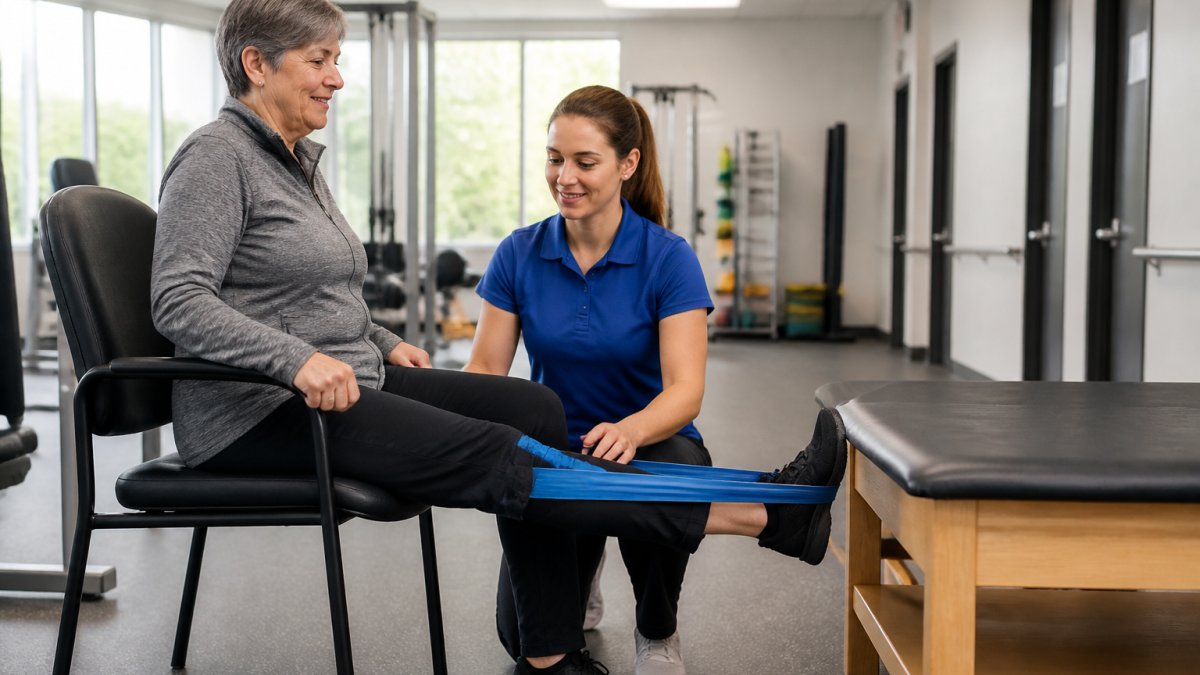
Post-surgical knee exercises fall into two groups: those that restore motion and those that rebuild strength and balance. Both matter, and skipping either one slows the whole plan. But the exercises only work if you can actually do them safely at home, and that setup is where most guides stop short. Establishing a consistent routine requires clear instructions on how to perform specific rehab exercises to ensure that your recovery remains on track.
Range of Motion and Quadriceps Sets
Range of motion work keeps the joint from locking up. Quadriceps sets, ankle pumps, and seated flexion stretches are the staples. A home exercise program from the University of North Dakota combined gluteal, hamstring, and quad isometrics with seated knee flexion stretches and documented steady progress. For a fuller set you can do at home, see our guide to rehab exercises for post-surgical recovery.
Gait Training and Balance Retraining
Walking mechanics change after surgery, and most people overcompensate without noticing. Gait training retrains a normal step. Balance retraining then protects you from falls. Together they rebuild confidence in the knee.
The Home Setup Nobody Tells You About
You will spend far more time exercising at home than in the clinic, and a few inexpensive modifications prevent the setbacks that erase weeks of progress:
- A firm, high chair with arms. Low sofas force you to rock forward and twist the knee to stand. A chair with arms lets you push up through your arms instead of your surgical leg.
- A raised toilet seat and shower chair. Most home bathrooms are too low and too slippery for the first month. A raised seat and a shower chair are the two highest-value purchases you can make before surgery.
- A reacher and a long-handled shoehorn. Bending to pick things up or put on shoes loads the knee in exactly the position it tolerates least.
- A resistance band and a low step. Most early strengthening can be done with a band and a single step, no gym required.
- Clear walkways and removed throw rugs. Falls in the first six weeks are the most common reason patients lose range of motion they had already earned.
How to Progress Without Flaring the Knee
The rule most therapists use: increase one variable at a time. Add reps before you add resistance, and add resistance before you add range. If the knee swells or stays warm for more than a few hours after a session, you did too much, back off the volume, no
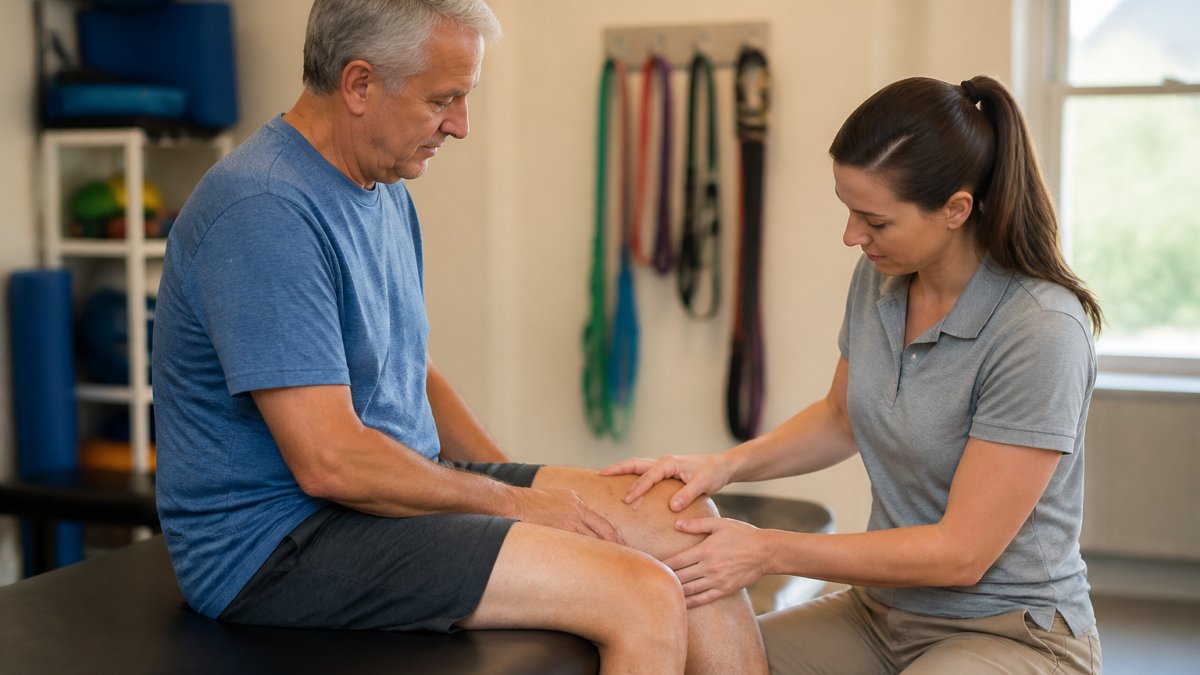
The Benefits of Manual Therapy for Knee Recovery
Dr. Mansour, a physician at Yale Medicine, puts the case plainly:
Click Here To Download Patient Information →
"Outpatient physical therapy is preferred as that allows access to more equipment that can help toward a faster recovery." -- Dr. Mansour, Physician at Yale Medicine (Yale Medicine News, 2026)
Prehab and Swelling Control: Preparing Before and After Surgery
Prehab is physical therapy before surgery, and the updated 2026 clinical practice guideline from the American Physical Therapy Association calls for preoperative exercise programs to improve both pre- and post-operative outcomes. Stronger quads going in means a stronger start coming out.
Beyond Exercise: Nutrition, Home Safety, and Mental Barriers
Recovery is not only exercise. Three factors competitors rarely mention decide how smoothly the weeks go.
Nutrition for tissue repair means enough protein and calories to rebuild muscle. Tissue needs building blocks, and healing burns energy.
Home modifications remove the small hazards that cause big setbacks. Clear walkways, a raised toilet seat, and a shower chair make daily life safer.
Fear of movement is real, and it slows recovery. If anxiety about re-injury is holding you back, our article on overcoming fear of movement after injury walks through how to work past it.
When to Call Your Surgeon and How to Spot a Setback
Call your surgeon for signs of infection, a hot or heavily swollen knee, calf pain, chest pain, or shortness of breath. Those are not therapy problems, and they need medical attention right away.
Setbacks in therapy look different. A sudden loss of motion, a new sharp pain, or a knee that gives way during walking all warrant a call to your therapist. Catching these early keeps a small issue from becoming a long delay.
How to Choose the Best Physical Therapy for Knee Surgery
At ABC Physical Therapy Cares, we treat one patient at a time, use advanced manual therapy including myofascial release and joint mobilization, and accept all insurances including no-fault and worker's comp. Book a physical therapy appointment online when you are ready to get started. Our licensed therapists hold advanced certifications.
Frequently Asked Questions
How long is physical therapy after a knee replacement?
Most patients attend formal physical therapy for 8 to 12 weeks, though the knee replacement rehabilitation timeline varies by individual. The 2026 clinical practice guideline from the American Physical Therapy Association emphasizes progressive strength and motor control training as the primary interventions. Research from Fyzical Therapy & Balance Centers reports that 85% of patients reclaim most normal activities by 12 weeks with consistent physical therapy. Your therapist will adjust frequency as range of motion, swelling, and functional mobility improve.
What post-surgical knee exercises should I avoid early on?
In the first weeks after surgery, avoid deep squats, high-impact jumping, and heavy resistance work that stresses the new joint. Skip exercises that cause sharp pain or force the knee past the range your surgeon approved. Focus instead on gentle range of motion, quadriceps sets, ankle pumps, and guided gait training. Your physical therapist will tell you when it is safe to add load. Pushing too hard early can increase swelling and slow the healing process.
How do the benefits of manual therapy for knee recovery work?
Manual therapy includes hands-on techniques such as myofascial release and joint mobilization that target joint stiffness, scar tissue management, and patellar mobility. The 2026 APTA guideline supports progressive interventions for restoring physical function after total knee arthroplasty. A therapist applies these techniques one-on-one to improve range of motion and reduce pain with movement. Manual therapy works best alongside therapeutic exercise and a structured home exercise program, not as a standalone treatment.
When should I start physical therapy after knee surgery?
Physical therapy should begin within 24 hours of surgery, according to standard post-operative guidance published by the National Center for Biotechnology Information. Early movement helps control swelling, prevents muscle atrophy, and supports joint stability. In practice, this often starts with ankle pumps and quadriceps sets in the hospital, then progresses to outpatient care. Ask your surgeon for a referral before surgery so you can schedule your first visit without delay.
Knee surgery recovery rewards patients who start early, stay consistent, and get hands-on care from a therapist who is focused on them alone. ABC Physical Therapy Cares builds phase-based plans around one-on-one treatment, manual therapy, and insurance support that removes the billing headache. Get started with ABC Physical Therapy Cares and take the next step back to the activities you miss.